Blog

  • What People Get Wrong about AI in Health and Safety

    What People Get Wrong about AI in Health and Safety

    As someone who has mapped the evolution of artificial intelligence onto the trajectory of my career as a safety professional, I have gained a solid perspective on how safety can benefit from this disruptive technology at this time.

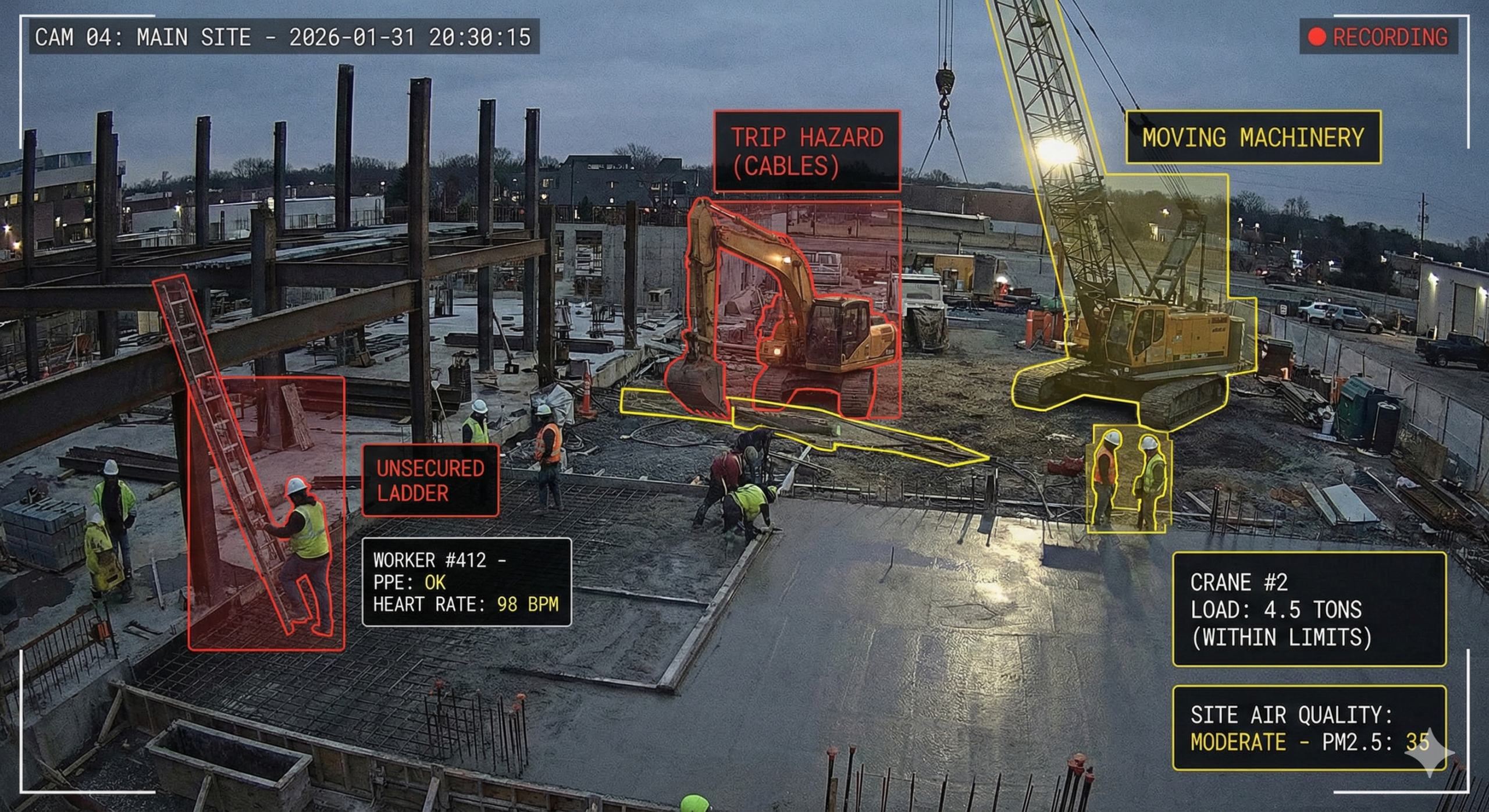
    Reading about AI in health and safety, you might come away with the perspective that AI can benefit us most by serving as our eyes. The AI-in-safety market has jumped on the most obvious, but perhaps least useful use of the tech – using it to spot hazards in our environment. And, except in specific instances, I would argue this is a misuse of AI in its current form for several reasons. First, it implies that the best way to manage safety is to establish a surveillance system to watch people at work. Second, it attempts to replace a skill we still want humans to have, identifying hazards in our environments. Lastly, there’s a hidden assumption that hazard identification is the bottleneck.

    George Orwell’s 1984 famously described a surveillance state where people’s every action was watched, recorded and scrutinized. The idea of connecting generative AI to video and having it evaluate and respond to the information it receives seems like a natural fit. I can understand the allure. Our perfect AI system could analyse work, recommend efficiencies and warn of impending danger. This sounds great, but there would be significant practical limitations to calibrating such a system. What constitutes a risk worth stopping work for? What constitutes a risk we can just monitor, categorize and keep track of? Even if we thought the AI were smart enough to exercise discretion, it would be tenuous legal grounds to point to your generative AI surveillance system if something went wrong.

    Some might argue that these technologies can gradually improve a user’s ability to identify hazards in the workplace. This is conceivable, but I remain skeptical. When I review outputs from AI hazard spotters, I often see disappointing results. Arrows don’t point to the hazardous part of something, descriptions are vague, and they generally don’t discriminate between hazards that pose little risk and those that are quite serious. From my experience using AI, I wouldn’t fully trust LLMs to conduct a risk assessment on my behalf without considering the circumstances myself.

    These AI systems assume that incidents occur because hazards go unseen. But in most workplaces, that’s rarely the core problem. Workers and supervisors often already know something is hazardous. The real barriers are systemic: production pressure, inadequate resources, lack of authority to stop work, or organizational cultures that don’t empower people to act on what they observe. An AI that spots the same hazards workers already see doesn’t solve the actual failure mode. It simply adds another layer of documentation while leaving organizational dysfunction untouched. Worse, it might create a false sense of security. Leadership may believe they’ve “addressed safety” by installing a monitoring system, but will they really want to respond to everything such a system identifies? This ties to the Heinrich/Bird pyramid critique that many modern safety thinkers make: the issue isn’t usually awareness at the sharp end; it’s the latent conditions and decision-making further up the chain. Karen Levy’s book Data Driven, which explores workplace surveillance in the trucking industry, examines the working lives of truck drivers whose driving is increasingly surveilled through electronic logging devices. Levy skillfully illustrates how digital oversight can discomfort workers who chose their profession for the freedom it promised, and the not-so-obvious impacts surveillance has on safety, productivity and how work is done.

    As you can see, I’m not sold on AI hazard spotters yet. I’m not saying visual hazard detection doesn’t have utility; I’m arguing that we need to think carefully about how these technologies are deployed. Let’s not let the allure of an all-seeing hazard detector lead us to systems with unforeseen consequences.
  • Automation vs. Augmentation

    Automation vs. Augmentation

    Last week at a safety conference, I was excited to see a talk on artificial intelligence in construction. My excitement quickly turned to disappointment when I realized the speaker merely promoted a construction camera system with basic AI functionality – tracking hardhat compliance and flagging puddles for cleanup. I’d seen these surface-level applications before. I wanted to hear about how the current wave of generative AI is revolutionizing construction work at a fundamental level. The presentation clarified that our industry is still grappling with how to meaningfully implement AI technology. In this article, I’ll explore two critical domains where AI is transforming safety management: first, its potential to automate traditional safety tasks like risk assessments and data analysis, and second, perhaps more importantly, how safety professionals can leverage AI to enhance their own effectiveness. This distinction between automation and augmentation is crucial for understanding AI’s true potential in construction safety.

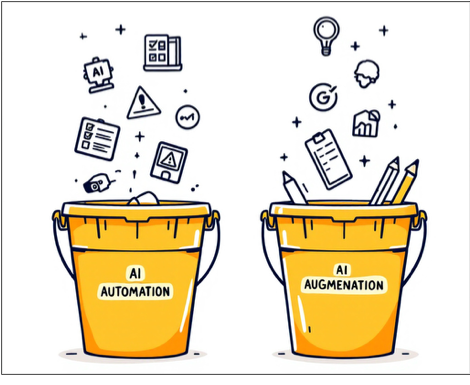
    Figure 1 Made using Flux 1.1 Image with prompt, “A clean, minimalist illustration of two construction buckets side by side against a white background. The left bucket is labeled ‘AI AUTOMATION’ and contains icons representing automated safety tasks – small symbols of checklists, data charts, cameras, and warning signs. The right bucket is labeled ‘AI AUGMENTATION’ and contains tools representing enhanced human work – a magnifying glass, a pencil, a clipboard, and a brain symbol. Both buckets should be the classic orange/yellow color of construction equipment, with clear black text labels. The icons inside should be simple, black line drawings floating slightly above each bucket, suggesting activity. Add a subtle shadow beneath each bucket for depth.

    The research on AI’s capabilities in construction safety tells an interesting story. Recent studies show that tools like ChatGPT can outperform human experts in certain aspects of risk management. One study even found that GPT-4 scored higher than human experts in a blind peer review of construction project risk management (Can ChatGPT exceed humans in construction project risk management?). But AI isn’t perfect; the same paper discusses how it struggles with more nuanced problems, unable to reproduce human intuition that comes from training, education, and years of human experience. 

    When I’ve experimented with AI vision models, I’ve found their ability to identify hazards impressive. That said, I struggle to see a future where we deploy cameras across construction sites and command an AI overlord to monitor compliance. No doubt some eager construction technologists are already working on such a project, but the whole thing feels misguided, not only for its obvious Big Brother undertones. The way I see it, we might need AI capable of identifying hazards and assessing risks, but only if it can show us something that isn’t obvious, like a missing hard hat. That and the technology must be elegantly introduced into the work environment so that it doesn’t alienate the workforce.

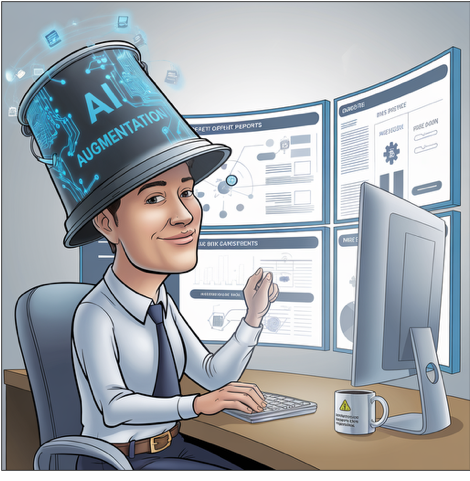
    Figure 2 Generated using Ideogram using prompt, ” A cartoon-style illustration of a safety professional sitting at a desk, wearing a construction bucket labeled ‘AI AUGMENTATION’ tilted slightly on their head like an unusual hard hat. The bucket should have glowing blue circuit patterns and small floating holographic icons emerging from it (safety symbols, clipboard, brain, magnifying glass). The professional is wearing typical office attire and is working at a modern computer setup with multiple screens. On the screens, show safety reports and risk assessments being actively enhanced with AI assistance (represented by subtle blue highlighting and floating text suggestions). The professional looks confident and slightly amused, suggesting they’re embracing this new technology. The overall style should be clean and professional but with a touch of whimsy, using a warm color palette with blue AI accents. Include a small coffee mug on the desk with a safety slogan for extra personality.”

    The other use case is the one I’ve been demonstrating in these articles. The one that I’ve also been using since I first discovered generative AI for myself. That is the use case that sees generative AI as tutor, assistant, teacher, mentor, planner, analyst, reviewer, editor, and a whole host of other functions it is great at serving. The distinction between these two domains – automation and augmentation – is crucial for understanding how AI will reshape safety management. When I use ChatGPT to help me write a job hazard analysis, I’m not replacing my expertise but amplifying it. The AI helps me consider angles I might have missed, suggests more straightforward ways to communicate risks, challenges my assumptions, and checks my biases. But ultimately, I’m the one making the decisions and ensuring the analysis fits our specific workplace needs.

    I use AI daily. Sit has so fundamentally changed the way I work that I’m convinced my productivity has significantly increased. Furthermore, I’ve seen coworkers overcome writing blocks and use AI to help them with perceived shortcomings that made them avoid certain types of safety work, like writing reports and proposals. Of course, there are the risks associated with using AI; these are innumerable and perhaps the topic of a separate article. But we mustn’t let the risks prevent us from getting to know this technology more. We don’t have a choice. Technology is moving so fast that the transformation of our workplaces is inevitable. For now, at least, I think the writing on the wall is clear – AI is best posed as an augmenter and not an Automator of our safety abilities.

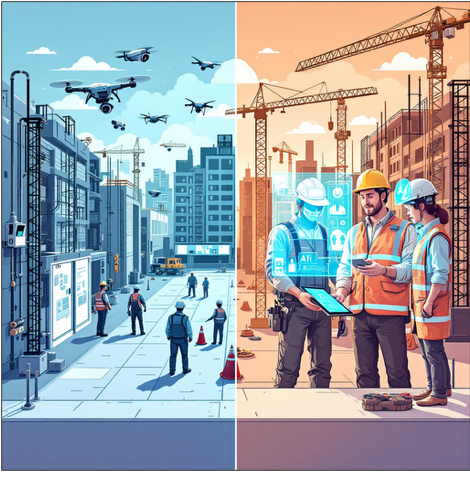
    Figure 3 Ideogram image created using prompt, ” A split-screen illustration showing two construction site scenarios. On the left, a sterile, automated site with surveillance cameras, drones, and robots monitoring workers (shown in cold, mechanical blues and greys) and telling them how to do their jobs. On the right, a warmer scene showing a safety professional collaborating with workers, using a tablet with holographic AI assistance floating above it, highlighting the human-AI partnership. The contrast should be clear but not cartoonish, using an architectural technical drawing style.”

    As we stand at this technological crossroads, the path forward for AI in construction safety is becoming more apparent. While the industry may be distracted by flashy automation solutions like AI-powered surveillance systems, the real revolution is happening more quietly in the daily work of safety professionals discovering AI’s potential to make their lives easier and the products of their work more palatable to those they serve. The distinction between automation and augmentation isn’t just semantic – it represents two fundamentally different approaches to incorporating AI into safety management. The automation path, focused on replacing human functions with AI systems, risks missing the nuanced, relationship-based nature of effective safety management. The augmentation approach described throughout this article leverages AI to enhance our existing capabilities, allowing us to work more effectively while maintaining the human judgment and contextual understanding crucial in our field. The future of safety management isn’t about choosing between human expertise and artificial intelligence; it’s about finding the sweet spot where both can work together. 

  • Context Drives Behaviour

    Context Drives Behaviour

    Rube Goldber Machines, Marbles, and AI

    Context drives behaviour, it’s true. There. If you were a contemporary safety professional who has read a few books, my title was successful in getting you this far, but it was a trap. This article isn’t about the ways in which the environment shapes the worker behaviour on our job sites, though it obviously does so; please just quit talking about it so much. No, this is an article about artificial intelligence.

    But don’t leave yet (please?).

    There are analogies between how we think about how context drives behaviour on the job site and how it drives behaviour when we interact with a large language model. What we commonly refer to as AI, you know: ChatGPT, Claude, Copilot, and so on. If you’ve dabbled with AI for any amount of time, you’ve no doubt realized that what you put in has a lot to do with what you get out. Similar to how the amount of effort we put into designing a system of work to enable the smooth flow of labour and cognition, the better our outputs will be.

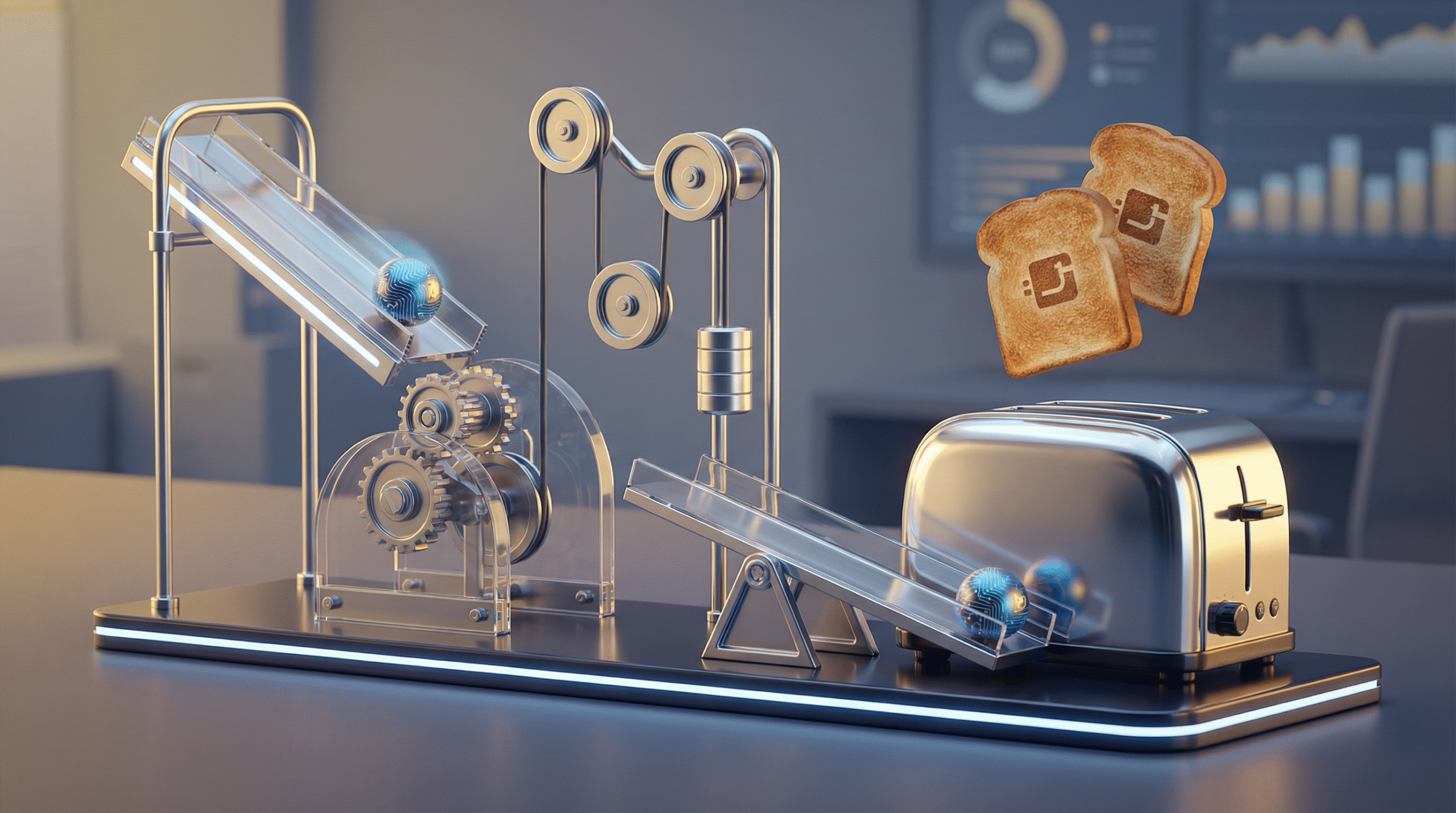
    Imagine in your mind’s eye a rube Goldberg machine, you know, one of those things that you design, and you place a marble at the top, and the marble works its way through a series of ramps, obstacles, gadgets, switches and the like, which makes its way down to turn on a toaster or perform some other task. In the same way, when we design the context for an LLM, we need to consider what our intelligence will need to bump up against, slide down, run into, or turn on in order to complete the task.

    For example, say we want a large language model to build an entire safety program manual. It would be a mistake to simply prompt a large language model with, “build a safety program manual,” and expect that we would get anything useful. This would be akin to building a Rube Goldberg machine with a single ramp. Yes, the marble will get to the bottom, but that was never the point. We need to get the marble to collide with a few more objects along the way.

    What does this look like?

    The first step we might take is to ask the LLM to research our industry and local regulations. Next, we might have it ask us questions to further clarify what it is we are trying to design. We might grant it access to tools so that it can review files and photos, and to folders containing some of our project-related files. We will want it to present its output in a particular format and style, so we will provide templates and instructions.

    Context drives behaviour, it’s true. There. If you were a contemporary safety professional who has read a few books, my title was successful in getting you this far, but it was a trap. This article isn’t about how the environment shapes worker behaviour on our job sites, though that’s also an important concept. No, this is an article about artificial intelligence.

    But don’t leave yet (please?)

    There are parallels between how we think about context driving behaviour on the job site and how it drives behaviour when we interact with a large language model. What we commonly refer to as AI: ChatGPT, Claude, Copilot, and so on. If you’ve dabbled with AI for any amount of time, you’ve no doubt realized that what you put in has a lot to do with what you get out. Similar to how the effort we put into designing a system of work to enable the smooth flow of labour and cognition correlates with better buildings, products and widgets.

    The Rube Goldberg Machine and the marble of synthetic intelligence

    Imagine in your mind’s eye a rube Goldberg machine, you know, one of those things that you design, and you place a marble at the top, and the marble works its way through a series of ramps, obstacles, gadgets, switches and the like, which makes its way down to turn on a toaster or perform some other task. Similarly, when we design the context for an LLM, we need to consider what our marble of synthetic intelligence will need to bump into, slide past, run into, or turn on in order to complete the task.

    For example, say we want a large language model to build an entire safety program manual. It would be a mistake to simply prompt a large language model with “build a safety program manual” and expect to get anything useful. This would be akin to building a Rube Goldberg machine with a single ramp. Yes, the marble will get to the bottom, but that was never the point. We need to get the marble to collide with a few more objects along the way.

    What does this look like?

    The first step we might take is to ask the LLM to research our industry and local regulations. Next, we might have it ask us questions to further clarify what it is we are trying to design. We might grant it access to tools so that it can review files and photos, and to folders containing some of our project-related files. We will want it to present its output in a particular format and style, so we will provide templates and instructions.

    As with building Rube Goldberg machines, our AI projects never work the first time. It’s only through careful, consistent, and observant iteration that we begin to predict what the marble is going to do with some reasonable degree of confidence. But even when we have everything lined up, they’re still a chance that, for whatever reason, the whole thing goes off course. But the beautiful thing about working with artificial intelligence is that it is self-reflective. We can’t ask the marble how to design its own Rube Goldberg machine, but we can ask a large language model how to help us get unstuck from a particular problem it’s involved in.

    So next time you go to work with a large language model, consider the problem you’re trying to solve. Then imagine that you are unleashing an intelligence that will pursue an answer to your question with the persistence of a marble being pulled downward by gravity. Your job is to learn the best ways to guide that intelligence towards solving your specific problem. Then, press Enter and observe what happens so you can further refine the process through trial and error.

    Good luck.

    So next time you go to work with a large language model, consider the problem you’re trying to solve. Then imagine that you are unleashing an intelligence that will pursue an answer to your question with the persistence of a marble being pulled downward by gravity. Your job is to learn the best ways to guide that intelligence towards solving your specific problem. Then, press Enter and observe what happens so you can further refine the process through trial and error.