As someone who has mapped the evolution of artificial intelligence onto the trajectory of my career as a safety professional, I have gained a solid perspective on how safety can benefit from this disruptive technology at this time.
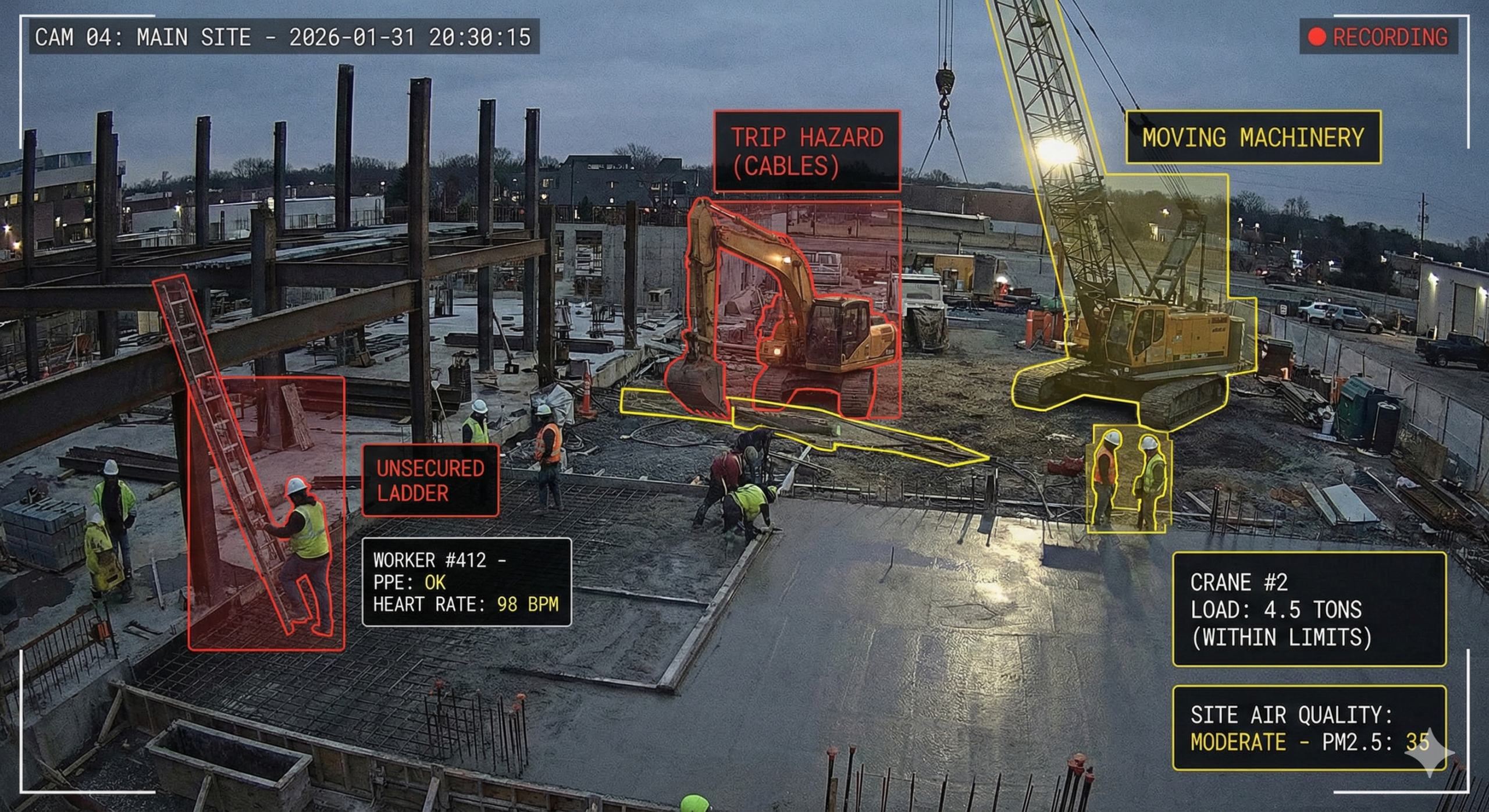
Reading about AI in health and safety, you might come away with the perspective that AI can benefit us most by serving as our eyes. The AI-in-safety market has jumped on the most obvious, but perhaps least useful use of the tech – using it to spot hazards in our environment. And, except in specific instances, I would argue this is a misuse of AI in its current form for several reasons. First, it implies that the best way to manage safety is to establish a surveillance system to watch people at work. Second, it attempts to replace a skill we still want humans to have, identifying hazards in our environments. Lastly, there’s a hidden assumption that hazard identification is the bottleneck.
George Orwell’s 1984 famously described a surveillance state where people’s every action was watched, recorded and scrutinized. The idea of connecting generative AI to video and having it evaluate and respond to the information it receives seems like a natural fit. I can understand the allure. Our perfect AI system could analyse work, recommend efficiencies and warn of impending danger. This sounds great, but there would be significant practical limitations to calibrating such a system. What constitutes a risk worth stopping work for? What constitutes a risk we can just monitor, categorize and keep track of? Even if we thought the AI were smart enough to exercise discretion, it would be tenuous legal grounds to point to your generative AI surveillance system if something went wrong.
Some might argue that these technologies can gradually improve a user’s ability to identify hazards in the workplace. This is conceivable, but I remain skeptical. When I review outputs from AI hazard spotters, I often see disappointing results. Arrows don’t point to the hazardous part of something, descriptions are vague, and they generally don’t discriminate between hazards that pose little risk and those that are quite serious. From my experience using AI, I wouldn’t fully trust LLMs to conduct a risk assessment on my behalf without considering the circumstances myself.
These AI systems assume that incidents occur because hazards go unseen. But in most workplaces, that’s rarely the core problem. Workers and supervisors often already know something is hazardous. The real barriers are systemic: production pressure, inadequate resources, lack of authority to stop work, or organizational cultures that don’t empower people to act on what they observe. An AI that spots the same hazards workers already see doesn’t solve the actual failure mode. It simply adds another layer of documentation while leaving organizational dysfunction untouched. Worse, it might create a false sense of security. Leadership may believe they’ve “addressed safety” by installing a monitoring system, but will they really want to respond to everything such a system identifies? This ties to the Heinrich/Bird pyramid critique that many modern safety thinkers make: the issue isn’t usually awareness at the sharp end; it’s the latent conditions and decision-making further up the chain. Karen Levy’s book Data Driven, which explores workplace surveillance in the trucking industry, examines the working lives of truck drivers whose driving is increasingly surveilled through electronic logging devices. Levy skillfully illustrates how digital oversight can discomfort workers who chose their profession for the freedom it promised, and the not-so-obvious impacts surveillance has on safety, productivity and how work is done.
As you can see, I’m not sold on AI hazard spotters yet. I’m not saying visual hazard detection doesn’t have utility; I’m arguing that we need to think carefully about how these technologies are deployed. Let’s not let the allure of an all-seeing hazard detector lead us to systems with unforeseen consequences.